Outdoor TV Installation in Las Vegas: What Actually Survives Out There
Outdoor living is one of the main reasons people move here, and a TV on the patio is one of the most requested additions we do. It's also the install with the widest gap between "worked out great" and "died in August," and the difference is almost entirely decided before anyone picks up a drill.
The First Decision: Is It an Outdoor TV?
Standard indoor televisions typically specify a maximum operating ambient temperature around 104°F. Las Vegas exceeds that on a routine basis every summer — often for weeks at a stretch, and a covered patio in July is not meaningfully cooler than the air around it. Add direct or reflected sun on a dark panel and the surface temperature goes well beyond the air temperature.
So the honest framing is: an indoor TV on a Las Vegas patio is a seasonal appliance with a shortened life, not an outdoor installation. Sometimes that's a conscious, acceptable trade — a spare TV on a shaded north-facing patio used mostly in spring and fall. What it isn't is a plan for a permanent outdoor entertainment area.
A purpose-built outdoor TV is sealed against dust and moisture, has no cooling fan to ingest grit, uses a UV-stable cabinet, and is rated for a far wider temperature range. In this climate it's the difference between one summer and many.
The Second Decision: How Much Sun Hits It
Outdoor TVs are sold in brightness classes, and picking the wrong one is the most common expensive mistake. Roughly:
| Location | Typical class | Las Vegas notes |
|---|---|---|
| Fully shaded — deep covered patio, north-facing | Full-shade models | Works, but watch for reflected glare off light stucco and pool water |
| Partial sun — pergola, east-facing, sun part of the day | Partial-sun models | The most common Las Vegas situation by far |
| Direct sun — west-facing, open patio, poolside | Full-sun models | Genuinely necessary here; a shade-class TV in direct west sun is unwatchable |
Go stand where the TV will go, at the time of day you'll actually be watching, and look at how much light is on that wall. Afternoon sun off a west-facing wall is the specific case that catches people out. There's more on glare and heat in our outdoor heat and glare guide.
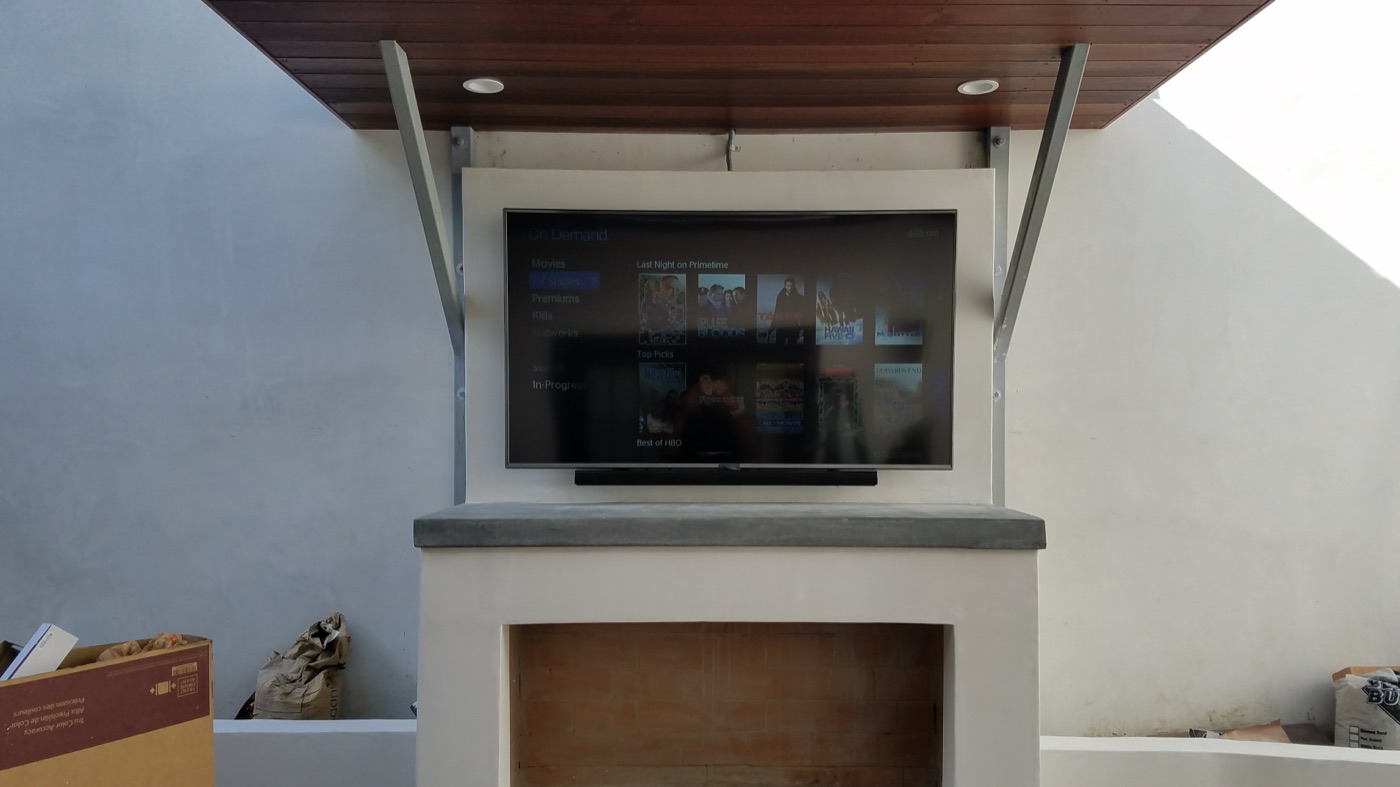
Mounting: What Changes Outdoors
- Hardware corrodes. Use stainless or hot-dip galvanized fasteners. Plain steel lags will rust-streak a light stucco wall within a season, and the streaks don't wash off.
- Every penetration is a water path. Exterior sealant behind the mount plate at each fastener, plus drip loops on cables so water runs away from connections rather than into them. Vegas rain is infrequent and then abruptly torrential — the monsoon downpour is what finds an unsealed hole.
- Wall type is usually masonry. Patio walls here are typically stucco over block or CMU. Different anchors, different tools — see block and CMU mounting and stucco mounting.
- Mount higher than you would indoors. Outdoor viewing is mostly standing and bar-stool, and higher keeps the screen out of splash range and out of reach at a party. Add downward tilt.
- Wind is real. Full-motion arms on an exposed patio catch gusts. A fixed or tilt mount is the more durable choice in an open area.
Power and Cable Done Correctly
This is where outdoor installs most often go wrong, and it's a safety issue rather than an aesthetic one:
- Outdoor receptacles need GFCI protection and a weather-resistant receptacle with an in-use ("bubble") cover — the kind that stays weathertight with a plug inserted, not a flip lid that only closes when empty.
- No indoor extension cords, ever, and nothing run across a walking surface.
- Cable should be UV-rated or run in conduit. Ordinary HDMI jacket becomes brittle in direct desert sun faster than most people expect.
- Drip loops on every cable entering an enclosure or device.
- If the run crosses from inside the house to outside, that penetration gets sealed properly on both sides.
What About an Enclosure?
Weatherproof enclosures let you use a standard TV outdoors and they solve dust and rain well. In Las Vegas the caveat is heat: a sealed box in summer sun becomes an oven unless it's actively ventilated or the location is genuinely shaded all day. If you're going the enclosure route here, ventilation isn't optional and shade placement matters more than it would in a milder climate.
Sound Outdoors
An outdoor TV's own speakers lose badly to open air, pool pumps, and the neighbors' AC condensers. Weather-rated outdoor speakers under the patio eaves, or a compact outdoor-rated soundbar, make far more difference than most people anticipate — and they let you keep the volume reasonable rather than blasting the whole cul-de-sac.
Frequently Asked Questions
Can I put a regular TV on my Las Vegas patio?
You can, but understand what you're buying. Most indoor TVs specify a maximum ambient operating temperature around 104°F, which Las Vegas exceeds routinely in summer, and they're not sealed against blowing dust. On a fully shaded patio used mainly in cooler months it can work for a while; as a permanent outdoor setup it's a short-lived one.
How bright does an outdoor TV need to be in Las Vegas?
It depends entirely on sun exposure at the spot. A deep shaded patio can use a shade-class model; a pergola or east-facing patio usually wants a partial-sun model; an open west-facing or poolside location genuinely needs a full-sun model to be watchable in the afternoon.
Do outdoor TVs need special power outlets?
They need a GFCI-protected, weather-resistant receptacle with an in-use cover that stays sealed with a plug inserted. Running an indoor extension cord out to a patio TV is both a code problem and a real shock hazard.
Will an enclosure let me use my existing TV outside?
It handles dust and rain well. The Las Vegas problem is heat — a sealed enclosure in summer sun gets hotter inside than the air around it. If you go that route here, active ventilation and a genuinely shaded location are both required, not optional.
Related Reading
Outdoor TVs and Las Vegas Heat, Sun and Glare · Weatherproofing an Outdoor TV for Monsoon Season · Mounting a TV on a Block or CMU Wall · TV Mounting Services