Mounting a TV on a Block or CMU Wall: A Las Vegas Homeowner's Guide
Concrete masonry unit — CMU, or just "block" — is the second most common thing we drill into in this valley. Every backyard perimeter wall is block. So are a lot of garage walls, casita walls, courtyard walls, and the exterior walls of older homes across the east side, Paradise, and central Las Vegas. Block holds a TV beautifully. It just doesn't forgive mistakes, and it makes almost none of the assumptions a drywall install makes.
The Single Most Important Thing to Understand About CMU
A standard block is hollow. Its face is a shell roughly 1¼ inches thick, with an air cell behind it and a solid web every eight inches or so where the two shells connect. Where your anchor lands within that geometry determines almost everything about how much load it can carry.
- Into a solid web — the strongest placement, but you can't see the webs, so you locate them by drilling or by knowing the block module.
- Into the face shell over a hollow cell — workable with the right anchor, but the anchor must be designed for hollow masonry, not for solid concrete.
- Into a mortar joint — easier to drill and easier to patch, but mortar is generally weaker than the block itself. Fine for light loads, not the first choice for a heavy panel.
- Grouted/reinforced cells — some Las Vegas walls have cells filled with grout and rebar, particularly at corners and at intervals along tall perimeter walls. These are as good as solid concrete when you find one.
What Hardware Actually Works
Every TV mount ships with wood lag screws and, often, plastic conical anchors. Neither belongs in block. What works:
- Sleeve anchors — the general-purpose choice for CMU. They expand along the length of the sleeve, which distributes load across the face shell instead of concentrating it at a single point.
- Wedge anchors — excellent in solid grouted cells or poured concrete, poor in a hollow face shell where the wedge has nothing to bite into.
- Concrete screws (Tapcon-style) — fast and clean for lighter loads and for securing raceways, less appropriate as the sole support for a large panel.
- Toggle-style masonry anchors — purpose-built for hollow block, they open behind the face shell. A good answer when a web isn't where you need it.
Whatever's used, the hole must be drilled with a hammer drill or rotary hammer and a carbide masonry bit, blown clean of dust before the anchor goes in (dust in the hole is a leading cause of anchors that spin instead of grabbing), and torqued to spec rather than "until it feels tight."
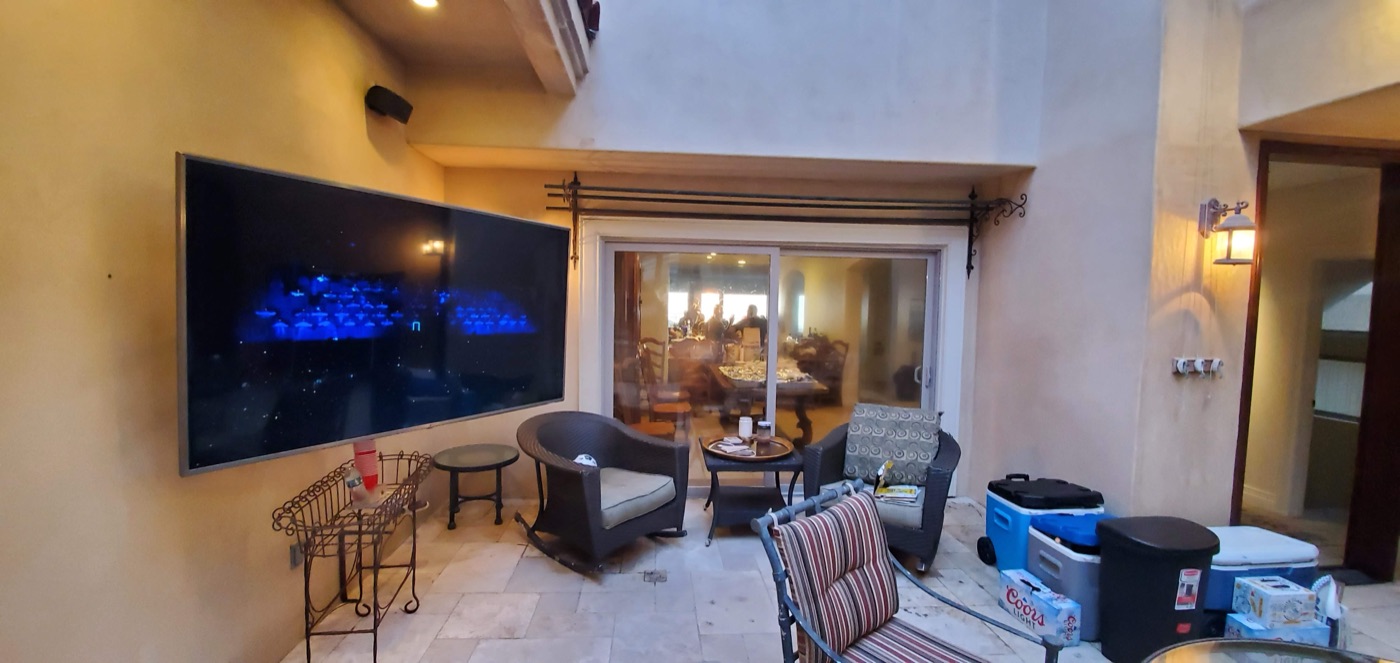
Layout Matters More Than It Does on Drywall
On a drywall wall you can shift a mount three inches without consequence. On block you can't: your fastener positions are dictated by where the webs and grouted cells are, not by where the center of the wall is. So the sequence inverts. First we find viable anchor points, then we lay out the mount around them, sometimes adding a horizontal backer board or a strut across the wall so the mount plate can sit where you want it while the anchors sit where the block allows.
The Cable Problem
This is the part that surprises people. A block wall has no cavity you can fish, so true in-wall concealment isn't available the way it is on framed drywall. The realistic options:
- Surface raceway, paintable and stucco-textured, run vertically to the outlet. Done well and color-matched it disappears at normal viewing distance.
- Route through an adjacent framed wall if the TV wall backs onto one — often possible in garages and casitas.
- Chase the block, cutting a channel and patching. It's real masonry work and is generally only worth it during a remodel when the surface is being refinished anyway.
- Come up through a cabinet or built-in below the TV, which hides the run entirely without touching the wall.
More on the tradeoffs in what wire concealment costs and what changes it.
Outdoor Block Walls
Backyard block is where most Las Vegas outdoor TVs end up. Add three things to the checklist: stainless or hot-dip galvanized anchors so you don't get rust streaks down a light-colored wall, sealant at each penetration, and an honest look at sun exposure before you commit to a west-facing wall. Our outdoor installation guide covers the rest.
Frequently Asked Questions
Can a block wall hold an 85-inch TV?
Comfortably — properly anchored CMU will out-carry a wood-stud wall. The load capacity comes from anchor selection and placement, not from the block's strength being in question.
Should I drill into the block or into the mortar joint?
For a TV mount, generally into the block. Mortar is easier to drill and easier to patch later, but it's typically weaker than the block itself. Mortar joints are a reasonable choice for lightweight items and raceways.
Can you hide wires in a block wall?
Not inside it, without cutting a chase into the masonry. The usual answer is a paintable surface raceway, or routing through an adjacent framed wall or a cabinet below.
Do I need special tools to mount on block?
Yes — a hammer drill or rotary hammer with carbide masonry bits, and masonry anchors rather than the wood lags in the mount's box. A standard cordless drill will burn out before it gets through a block face shell.
Related Reading
How to Mount a TV on a Stucco Wall · What In-Wall Wire Concealment Costs · Outdoor TV Installation for Las Vegas Patios · TV Mounting Services