What In-Wall Wire Concealment Costs in Las Vegas — and What Changes It
Cable concealment is the step that decides whether a mounted TV looks finished or looks like a TV someone hung on a wall. Our in-wall wire concealment starts at $299. What follows is what that work actually is, and the specific things about a Las Vegas wall that make it simpler or harder.
What "In-Wall" Actually Means
Done properly, concealment is two separate circuits handled two different ways:
- Power. You cannot legally or safely run a standard extension cord inside a wall cavity — flexible cord isn't rated as permanent wiring. The correct solution is a UL-listed recessed in-wall power extension kit: an inlet behind the TV, an outlet near the floor, and code-compliant cable in between. If an installer proposes fishing a power strip cord up the wall, that's the moment to stop.
- Low-voltage. HDMI, Ethernet, optical, and speaker cable can run in the cavity directly, and in-wall-rated (CL2/CL3) cable is the right choice for anything permanent.
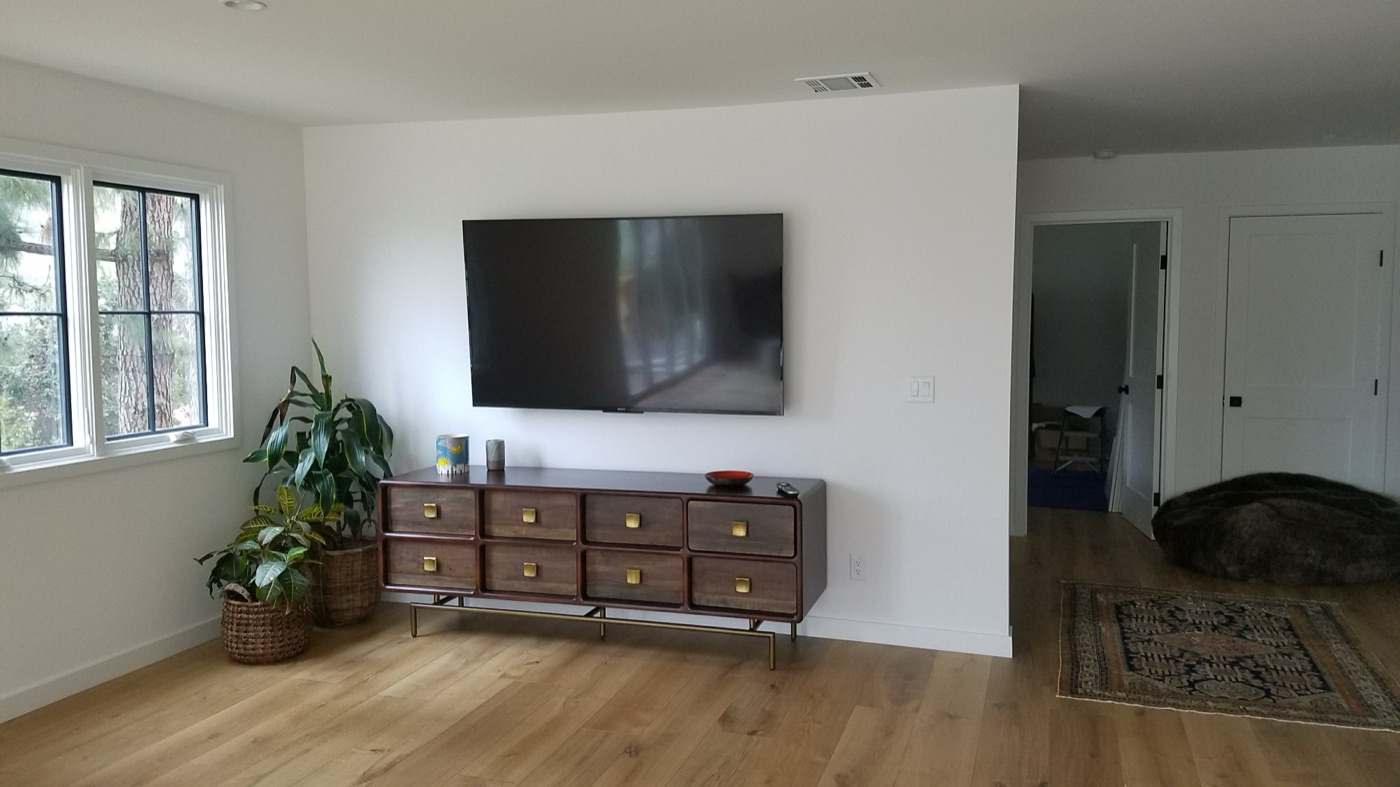
The visible result is two small plates — one hidden behind the TV, one at outlet height — and nothing else.
What Makes a Wall Easy or Hard
Easy: newer interior drywall
Most homes built in Skye Canyon, Providence, Inspirada, Cadence, Mountain's Edge, and Valley Vista are standard wood-frame drywall. An interior wall with a clear cavity and no plumbing or ductwork in the path is close to a best case: two openings, a fish, a mount, a patch. Our Centennial Hills cable-hiding guide goes into what we see in those specific neighborhoods.
Moderate: exterior-facing and two-story walls
Insulation, fire-blocking lumber mid-cavity, and horizontal bracing all show up in Las Vegas framing and all have to be routed around. None of them stop the job; they add time and sometimes shift the low outlet a few inches off where you'd have picked it.
Hard or impossible: solid masonry
A stucco-over-CMU or solid block wall has no cavity to fish. On those walls the honest options are a surface raceway painted to match, routing through an adjacent framed wall, or bringing the cable down inside a built-in or cabinet. Anyone promising invisible in-wall power on a solid block wall either hasn't looked at the wall or plans to cut a channel into masonry, which is a much bigger job than a standard concealment. More detail in our block and CMU wall guide.
Special case: over a fireplace
A fireplace chase often has framing, flue clearances, and a firebox in the way, so the cable path usually goes around the surround rather than straight down. It's very doable, it's just not the ten-minute version.
What Moves the Number Above the Starting Rate
- Masonry or stucco-over-block instead of drywall
- Number of cables — adding Ethernet, a second HDMI for future gear, or speaker runs
- Distance from the TV to the nearest usable outlet or equipment location
- Obstructions found in the path: fire blocking, insulation baffles, existing plumbing or HVAC
- Height, particularly a two-story or vaulted feature wall
- Whether equipment is moving into a closet or cabinet, which turns one run into several
Is It Worth It?
It's the difference customers comment on most, and it's cheapest to do at the same appointment as the mount — the wall is already open, the TV is already off, and the access is already there. Doing it later means coming back, taking the TV down, and doing the same work with more steps. If in-wall concealment isn't possible on your wall, a no-cutting alternative still gets you most of the way there.
Frequently Asked Questions
Do you have to cut into my drywall?
For true in-wall concealment, yes — two openings roughly the size of an electrical box, both of which end up covered by plates. If you'd rather nothing was cut, there are surface-mounted options that hide cable behind a paintable channel instead.
Can you hide the wires without adding a new outlet?
For low-voltage cable, yes. For power, the safe method is a rated in-wall extension kit, which by design puts an inlet behind the TV and an outlet lower on the wall. That lower outlet is what makes the whole thing code-compliant rather than a cord in a cavity.
Is in-wall concealment possible on a stucco exterior wall?
It depends on what's under the stucco. Stucco over wood framing usually has a cavity and is workable. Stucco over block does not, and needs a surface solution or a different wall. A photo plus the age of the home usually tells us which you have.
Can you conceal cables for a TV that's already mounted?
Yes. We take the TV down, do the concealment, and re-hang it. It's more steps than doing both at once, which is why concealment is worth deciding on before the first install rather than after.
Related Reading
In-Wall Cable Concealment Services · Hiding TV Wires Without Cutting Drywall · TV Mounting Cost in Las Vegas (2026) · Mounting a TV on a Block or CMU Wall