How to Hide TV Wires Without Cutting Into the Wall
In-wall concealment is the cleanest result, but plenty of situations rule it out: a rental, an HOA restriction, a solid block or masonry wall with no cavity, a wall packed with plumbing, or simply a homeowner who doesn't want holes cut. The good news is that the no-cutting options have gotten genuinely good. Here they are, ranked by how they actually look when finished.
1. Paintable Surface Raceway — Best No-Cut Result
A rigid channel that mounts to the wall surface, holds power and A/V cable, and takes paint. The reason cheap versions look bad and good ones nearly disappear comes down to three details:
- Profile. Low, wide, flat channels read as trim. Tall, narrow, boxy ones read as a plastic tube on the wall.
- Paint. It has to be painted with your actual wall paint, not a "close enough" white. Prime it first — most raceway plastic rejects paint without primer.
- Alignment. Dead vertical, centered under the TV, terminating at the outlet. A raceway that's a degree off plumb is the thing the eye catches.
Done properly on a matte wall, most people don't notice it. This is our default recommendation when in-wall isn't available, particularly on block and masonry walls.
2. Route Behind Furniture
If there's a credenza, console, or built-in below the TV, the cable only has to survive the visible gap between the bottom of the screen and the top of the furniture — often as little as 12 to 18 inches. A short raceway or even a well-dressed cable bundle across that span is essentially invisible from seated height, and everything below disappears behind the furniture. Cheap, fast, and surprisingly effective.
3. Baseboard and Corner Channel
Cable can run horizontally in a slim channel that sits on top of the baseboard, or vertically tucked into a wall corner where two planes meet. Both exploit lines the eye already expects to see. Corner routing works especially well when the TV is near a corner, which happens a lot in Las Vegas great rooms where the fireplace and the TV wall meet.
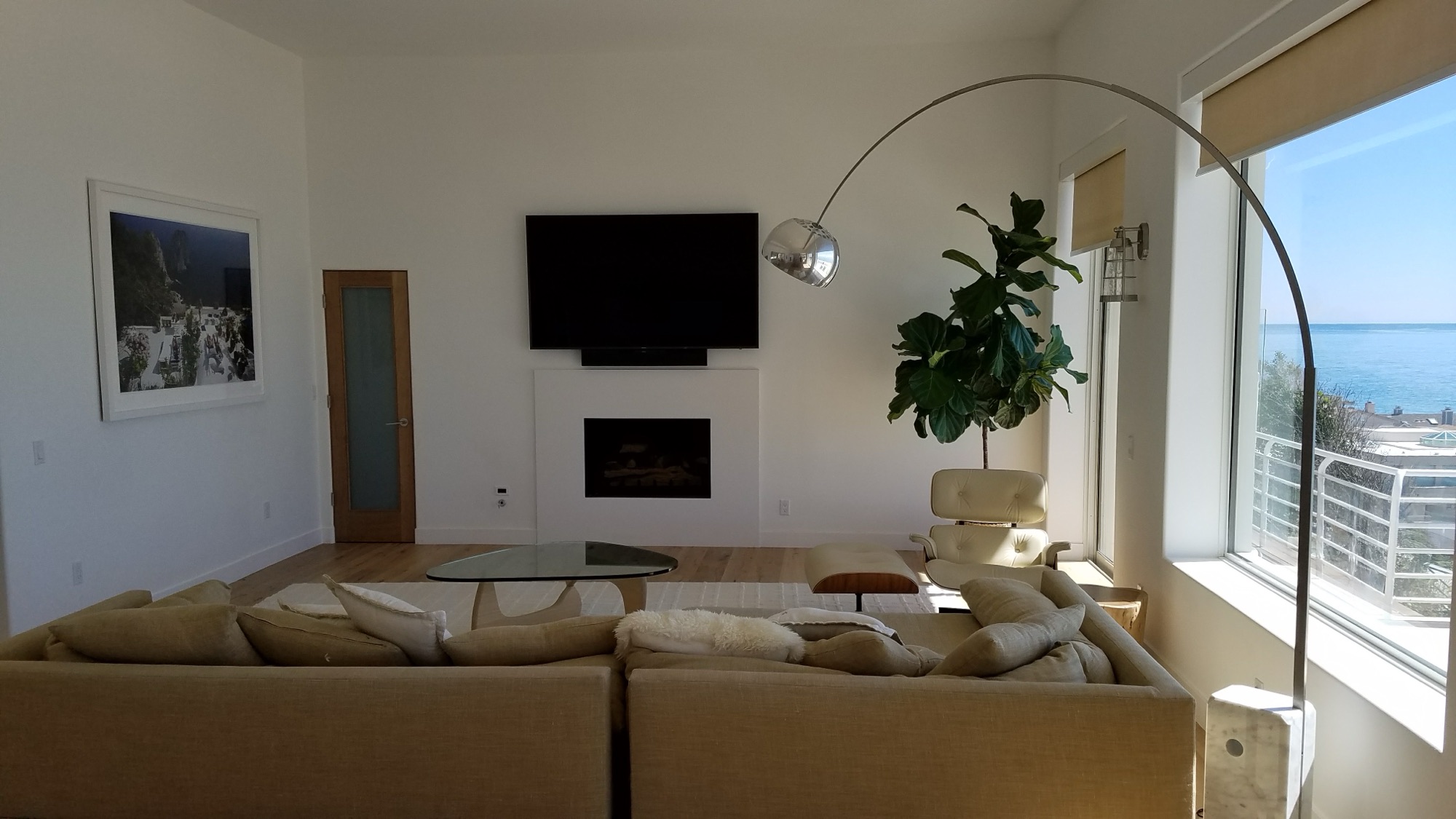
4. Cord Cover Sleeves — Fast, Not Beautiful
A fabric or neoprene sleeve that bundles multiple cables into one tidy column. It doesn't hide the run, it just makes six cables look like one. Take it for what it is: the ten-dollar improvement, useful in a rental or a bedroom where the wall isn't a focal point.
5. Cut the Cable Count Instead
Sometimes the best fix is having less to hide.
- Move the source devices. A streaming stick powered from the TV's own USB port eliminates a device and its power supply entirely.
- Use the TV's apps instead of an external box, if the TV's interface is decent.
- One HDMI, not four. If a receiver or soundbar with HDMI switching sits below the TV, a single HDMI cable runs up the wall instead of one per device.
- Wireless HDMI transmitters exist and work, though they add latency, cost, and another power supply at the TV end — which means you still have a power cable to hide. They solve half the problem.
- Some premium TVs ship with a single-cable box that carries power and video in one thin run to a separate connection box. If you're still shopping, that feature genuinely simplifies this whole problem.
What Not to Do
Two things worth stating plainly. Don't staple or nail through cable — it's a fire and shock risk and it damages the conductor even when it doesn't cut it. And don't run an ordinary extension cord inside a wall to shortcut the power problem: flexible cord isn't rated for permanent in-wall use, and it's the single most common unsafe shortcut in DIY TV installs. If power is going inside a wall, it needs a UL-listed in-wall power extension kit. Details in our wire concealment guide.
Which One Fits Your Situation
| Your situation | Best option |
|---|---|
| Renting, want it reversible | Furniture routing or a removable raceway |
| Solid block or masonry wall | Painted surface raceway |
| Credenza or console under the TV | Short raceway across the visible gap |
| Bare wall, want the cleanest look, drywall construction | Full in-wall concealment is worth reconsidering |
| Bedroom or secondary room | Cord sleeve — good enough, five minutes |
Frequently Asked Questions
Can you hide TV wires without any holes at all?
Yes. A surface raceway needs only small fastener holes or can be run with adhesive backing on a sound painted wall, and furniture routing needs none. What you can't do without holes is a true in-wall run, since that requires openings for the inlet and outlet plates.
Do paintable raceways actually look good?
When they're the right profile, primed and painted with your actual wall color, and run dead plumb — genuinely yes. Most bad-looking raceway installs fail on one of those three points rather than on the product itself.
Is it safe to run an extension cord inside the wall to hide it?
No. Flexible cord isn't rated as permanent in-wall wiring, and it's the most common unsafe shortcut in DIY TV installs. If power goes inside the wall, it needs a UL-listed in-wall power extension kit.
Will a wireless HDMI transmitter get rid of all my cables?
Not all. It removes the video cable, but the TV still needs power, and the transmitter needs power too. It's a partial solution that adds latency and cost — worth it in specific situations, not a general answer.
Related Reading
What In-Wall Wire Concealment Costs · TV Mounting for Renters in Las Vegas · Mounting a TV on a Block or CMU Wall · In-Wall Cable Concealment Services