How to Mount a TV on a Stucco Wall in Las Vegas (Without Cracking It)
Nearly every home in the Las Vegas valley has stucco somewhere, and it's the surface homeowners are most nervous about drilling into — with good reason. Stucco cracks, and once it does, the repair is visible unless it's done carefully. The good news is that mounting into stucco is routine work when you know what's behind it. The bad news is that "stucco" describes a finish, not a wall, and the wall underneath is what actually determines the job.
First: What's Actually Behind Your Stucco?
In Las Vegas there are two common answers, and they lead to completely different installs.
Stucco over wood framing (most tract homes, 1990s–present)
Three coats of stucco over metal lath and building paper, over plywood or OSB sheathing, over 2×4 or 2×6 wood studs at 16 inches on center. This is what you'll find on the exterior of most homes in Summerlin, Providence, Inspirada, Mountain's Edge, Aliante, and Cadence. It behaves much like a drywall wall from a mounting standpoint — you're still hitting wood studs, just through a hard, brittle crust.
Stucco over CMU block (older homes and many patio/garden walls)
Stucco applied directly over concrete masonry units. Common on older east-valley and central Las Vegas homes, on some detached casitas, and on almost every backyard perimeter wall in the city. There are no studs. Anchoring is entirely a masonry problem — covered in our block and CMU guide.
The quick field test: tap the wall. Framed stucco sounds hollow between studs and solid at them. Block sounds uniformly dead everywhere. A long masonry bit's first half-inch also tells you immediately — behind stucco over frame there's give; behind block there isn't.
Why Stucco Cracks When People Drill It
Two mistakes cause almost all of it:
- Starting with the hammer function on. A rotary hammer set to hammer mode blasts through the brittle finish coat and spalls a crater around the hole. The correct sequence is to drill the stucco layer in rotation-only mode with a masonry bit, then switch modes once you're through the crust and into whatever is behind it.
- Drilling too close to an edge or a control joint. Stucco has planned crack lines. Putting a lag within an inch or two of one invites the crack to propagate.
A strip of painter's tape over the drill point also stops the bit walking across the finish and leaving scratch marks.
The Right Sequence on Stucco Over Frame
- Find the studs, then verify. A stud finder often reads unreliably through metal lath — the lath itself trips the scanner. The dependable method is measuring from a known reference (a corner, a window jamb, an outlet) at 16-inch intervals, then confirming with a small pilot bit. See finding studs in Las Vegas homes.
- Tape and mark the exact hole locations, level the mount plate, and check twice. Extra holes in stucco are permanent.
- Drill the finish coat with a masonry bit in rotation-only mode until you're through the lath.
- Switch to a wood bit sized for your lag shank and drill the pilot into the stud.
- Use long-enough lags. Stucco plus sheathing can eat 1½ inches before you reach framing. A 2½-inch lag that would be plenty on drywall may barely bite. Standard practice is lags long enough to get a solid 1½ inches of thread into the stud itself.
- Seal exterior penetrations. Outdoors, every hole is a water path. Exterior-grade sealant behind the mount plate at each fastener is not optional, even in a dry climate — monsoon-season driven rain finds those holes.
Indoors vs. Outdoors on Stucco
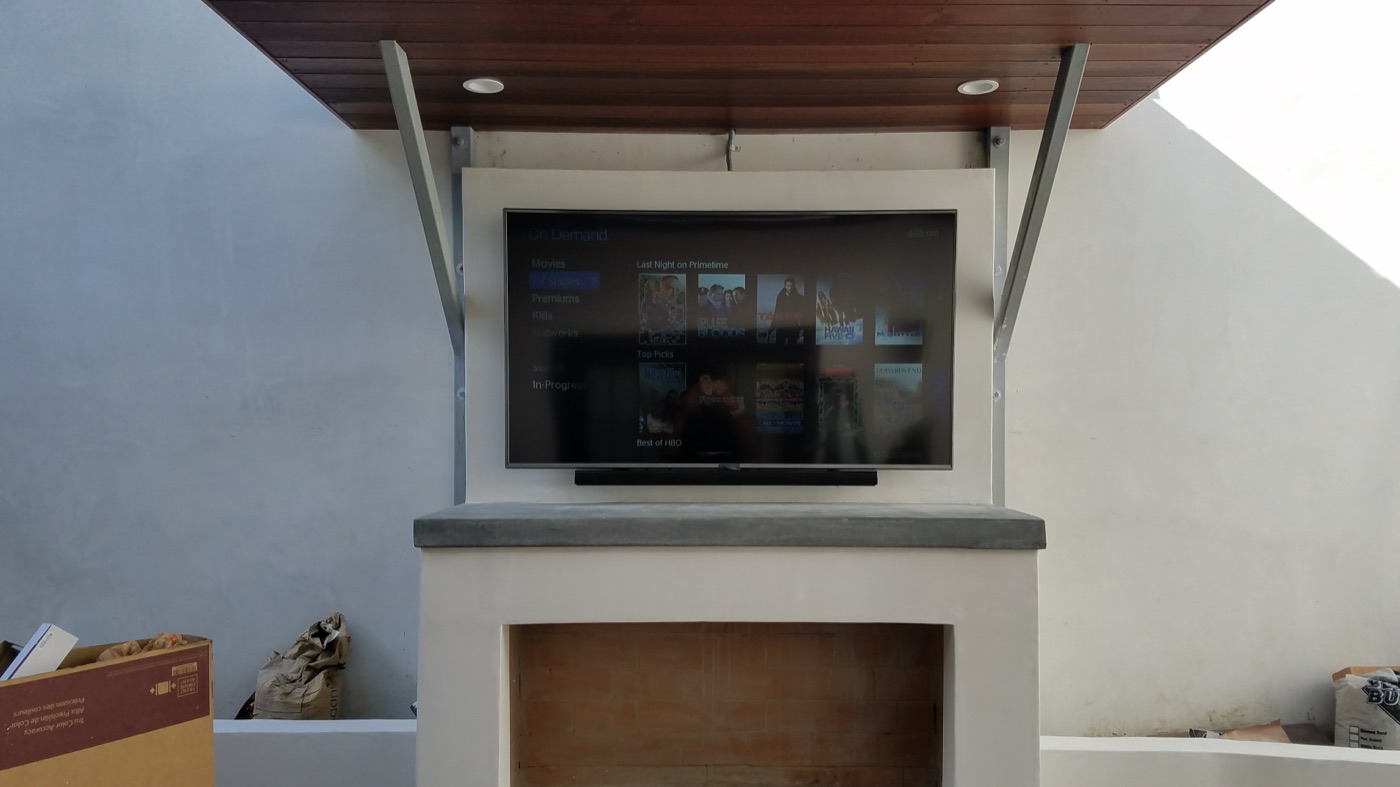
Interior stucco (accent walls, some entryways, Santa Fe-style interiors) is the same procedure minus the sealing step. Exterior stucco adds three considerations: sealing every penetration, using stainless or hot-dip galvanized hardware so the fasteners don't rust-stain your wall, and confirming the TV itself is rated for the location. A standard indoor TV on a west-facing Las Vegas patio wall will not survive a July — see our outdoor TV heat guide.
When to Stop and Call Someone
If a pilot hole comes back with no wood, sand-colored dust, or resistance that doesn't change, you're probably in block, and the lag screws in your mount's box are the wrong hardware entirely. If you hit something metallic that isn't lath, stop — conduit and copper both run in exterior walls. And if you're mounting a large panel above eye level on a wall you're not certain about, the cost of getting it wrong is a cracked wall and a dropped TV, not just a wasted afternoon.
Frequently Asked Questions
Will mounting a TV crack my stucco?
Not if the finish coat is drilled in rotation-only mode with a masonry bit and the holes are kept away from control joints and edges. Cracks come from hammering through brittle stucco, not from the fastener itself.
How do I know if my stucco is over wood or over block?
Tap the wall and listen for a hollow spot between studs — framed walls have one, block walls don't. A test drill also answers it in seconds: wood shavings mean framing, gray or sandy dust means masonry.
Can you mount a TV on an exterior stucco wall in Las Vegas?
Yes, and we do it regularly for patios and outdoor kitchens. The two things that matter beyond anchoring are sealing each fastener penetration and making sure the TV is an outdoor-rated model or is shaded and ventilated well enough to survive summer ambient temperatures.
Can the wires be hidden in a stucco wall?
If the stucco is over wood framing, usually yes on the interior side. If it's over block, there's no cavity, so the answer is a surface raceway or a route through an adjacent framed wall.
Related Reading
Mounting a TV on a Block or CMU Wall · Finding Studs in Las Vegas Homes · Outdoor TV Installation for Las Vegas Patios · TV Mounting Services