Heat, Sun and Glare: Why Outdoor TVs Fail in Las Vegas (and How to Prevent It)
There are four separate ways Las Vegas sun ruins an outdoor TV, and they're commonly lumped together as "it's hot out here." They're not the same problem and they don't have the same fix, so it's worth pulling them apart.
1. Ambient Heat
The simplest one. Most indoor televisions specify a maximum operating ambient temperature of about 104°F. Las Vegas summer afternoons regularly sit above that, and a covered patio only shades the panel — it doesn't cool the air. Electronics don't fail dramatically at 106°F; they degrade. Capacitors and power supplies age faster at elevated temperature, which is why the failure shows up as a TV that dies in its third summer rather than one that shuts off on the first hot day.
Fix: a TV rated for the temperature range, or accept a shortened service life. There's no clever workaround for ambient air.
2. Solar Heating of the Panel Itself
This is the one that surprises people. A television screen is essentially a large dark flat surface, and a dark surface in direct desert sun gets dramatically hotter than the surrounding air — far past what the ambient reading suggests. That heat is being applied directly to the liquid crystal layer.
On many LCD panels the visible symptom is a dark blotch spreading across the screen — the display effectively going black in the heated area. It often recovers as things cool, but repeated cycles are not good for the panel. Outdoor-rated TVs address this with reflective layers, better thermal management, and much higher brightness.
Fix: keep direct sun off the screen. Shade beats every other mitigation, and it's free if you plan the location around it.
3. UV Degradation
Ultraviolet exposure yellows and embrittles plastics over time. Southern Nevada gets a lot of it. On a standard indoor TV used outdoors, the bezel and rear cabinet go chalky and brittle within a couple of years, cable jackets crack, and any adhesive gasket dries out. Outdoor televisions use UV-stabilized housings specifically for this.
Fix: UV-stable equipment, and UV-rated cable or cable in conduit for everything that runs outdoors.
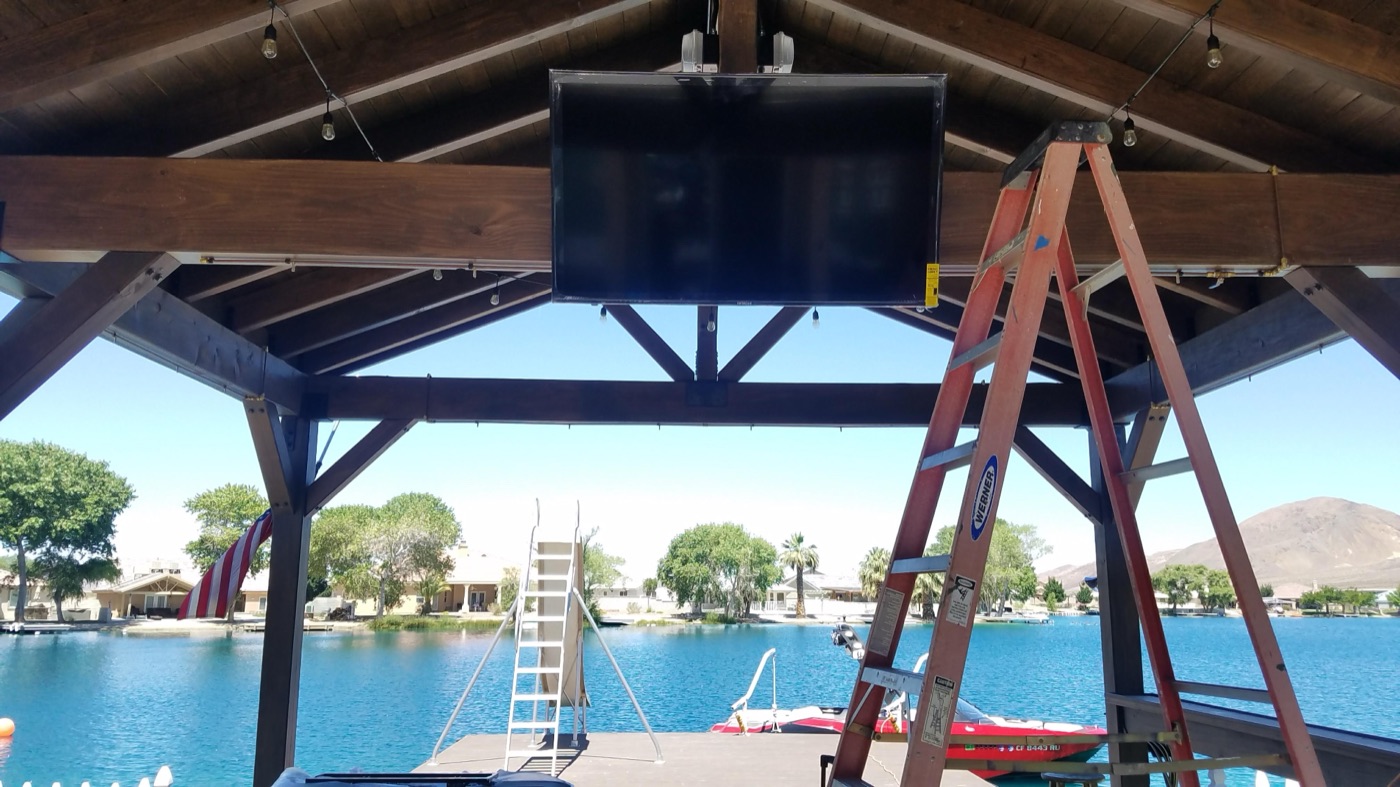
4. Glare — the One That Doesn't Break Anything and Ruins Everything
A TV can be perfectly healthy and completely unwatchable. Glare in Las Vegas outdoor spaces comes from more directions than people expect:
- Direct sun on the screen — obvious, and worst on west-facing patios from about 3pm on.
- Reflected light off light-colored stucco. The valley's default beige and cream walls are efficient reflectors, and a bright wall opposite the TV can wash out the picture even when the screen itself is shaded.
- Pool reflection. A pool between the seating and the TV throws moving light directly at the screen for a good part of the afternoon.
- Sky glare. Open patios take a lot of diffuse light from a bright desert sky even with no direct sun at all.
Fixes, in order of effectiveness: a north-facing or deeply covered location; a matte or anti-glare outdoor panel; a high enough brightness class to overcome the ambient light; a tilting mount so the screen faces down and away from the brightest part of the sky; and shade sails, retractable awnings, or planting that blocks the specific low afternoon angle.
The Ten-Minute Site Survey Worth Doing
Before buying anything, go outside at the times you'd actually watch — say 3pm and 7pm in summer — and check three things at the proposed TV location:
- Is there direct sun on the wall? For how long, and at what angle?
- Where is reflected light coming from — a bright wall, the pool, a neighbor's window?
- Where will people actually be sitting or standing, and what's behind them?
Ten minutes of this changes the equipment decision more than any spec sheet, and it's the step almost nobody does.
Winter Matters Too
It's easy to plan entirely around summer, but Las Vegas winter nights drop below freezing several times most years, and outdoor TVs also have a minimum operating temperature. Purpose-built models handle the full swing; that's part of what you're paying for. A TV that's been sitting at 34°F needs a few minutes to come up to temperature before it displays properly, which is normal rather than a fault.
Frequently Asked Questions
Why does my outdoor TV screen go black in patches in the summer?
That's usually solar heating of the panel itself. A dark screen in direct sun gets far hotter than the surrounding air, and the liquid crystal layer stops behaving normally in the heated area. It typically recovers as it cools, but repeated cycles shorten the panel's life. Shade is the real fix.
Does a covered patio protect a TV from Las Vegas heat?
It protects the screen from direct sun, which matters a great deal. It does not lower the air temperature, so ambient heat is still a factor — a covered patio in July is still well above the roughly 104°F limit most indoor TVs specify.
Which direction should an outdoor TV face in Las Vegas?
Ideally the screen faces north, or sits deep enough under cover that the low western sun never reaches it. West-facing open patios are the hardest case, because that's exactly when people are outside and exactly when the sun is lowest and most direct.
Will a brighter TV fix glare?
Partly. Higher brightness is how full-sun outdoor models stay watchable, and it genuinely works. But shade plus a matte panel plus a sensible viewing angle solves more of the problem for less money than brightness alone.
Related Reading
Outdoor TV Installation for Las Vegas Patios · Weatherproofing an Outdoor TV for Monsoon Season · Mounting a TV Over a Fireplace · TV Mounting Services