Moving Into a New Build in Enterprise or Mountain's Edge: A First-Month AV Checklist
The southwest valley — Enterprise, Mountain's Edge, Rhodes Ranch, Silverado Ranch, and the newer subdivisions filling in along Blue Diamond and Cactus — has been the busiest new-construction corner of Las Vegas for years. If you've just closed on one, there's a short window right after move-in when a handful of decisions are cheap and easy that become expensive and disruptive six months later.
Here's the checklist, roughly in the order it's worth doing.
Week One: Find Out What You Actually Bought
1. Locate the structured wiring panel
Most new southwest-valley homes have one — usually a recessed metal can in a closet, a laundry room, or the garage. Open it. What's terminated there tells you what the builder ran: coax to some rooms, Cat5e or Cat6 to others, sometimes nothing but a splitter. This is the map for everything that follows.
2. Verify the "TV pre-wire" at each location
A builder TV pre-wire is typically a recessed box with an outlet and an empty conduit, at a height the builder chose. Two things to check: whether that height matches where your TV should actually sit for comfortable viewing, and where the conduit actually terminates. Frequently the answer to the first is "no" and the answer to the second is "somewhere unhelpful."
3. Check where the router ended up
If the internet terminates in a metal panel in the garage at the corner of the house, you have a Wi-Fi problem waiting to happen — and in a stucco home it's a bad one. See why stucco and low-E glass wreck Wi-Fi. Moving the router to a central, open, elevated spot is free and it's the highest-value thing on this list.
4. Walk the sun
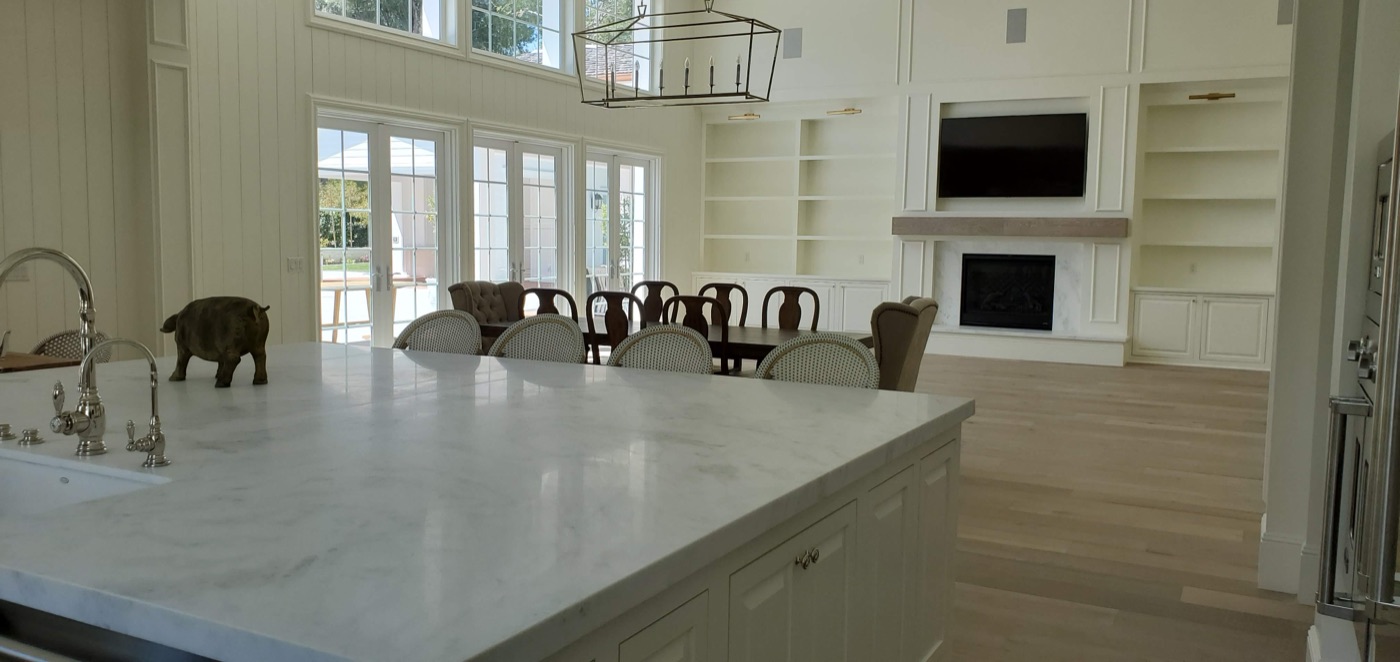
Spend one afternoon noting where direct sun lands in the great room at 3pm and 6pm. Southwest-valley homes take a lot of low western light, and that observation decides TV wall selection, whether you need a matte panel, and what window treatment to prioritize.
Weeks Two to Four: Decide Before You Furnish
5. Pick the TV wall before the furniture arrives
It's much easier to place a sectional around a decided TV position than to relocate a TV around delivered furniture. Consider the wall perpendicular to the main glass, and check what's behind the wall you're considering.
6. Measure the seating distance, then buy the TV
Not the other way around. Our sizing guide has the math. Most new-build great rooms in this area land at 75 to 85 inches.
7. Handle the feature wall question early
If your great room has large-format tile, stacked stone, or a flush linear fireplace — the standard package in current southwest-valley builds — the anchoring approach changes and there may be gas, venting, or LED wiring inside that wall. This is the one wall type worth resolving before anyone drills a test hole. See mounting on tile and stone.
8. Get cable concealment done at the same time as the mount
The wall is open, the TV is off, and the access is already there. Doing it later means taking everything down and redoing the same work with more steps. Newer construction here is close to a best case for in-wall runs.
If You Haven't Closed Yet: The Pre-Drywall Window
If your home is still in construction and you can get access after framing and before drywall, this is where a small amount of foresight pays for years:
- A plywood backer between the studs behind every planned TV location
- Conduit — not just cable — from each TV location to the equipment spot
- Cat6 to every TV, every likely ceiling access point, the office, and the patio eave
- An outlet at TV height plus one at floor level below it
- Speaker runs for a future surround system and in-ceiling height channels
- Power and ventilation at the structured panel location, ideally somewhere central rather than the garage corner
The Patio, Because This Is Las Vegas
Southwest-valley backyards are mostly block-walled with a covered patio, and outdoor TVs are one of the most common second-phase requests we get out here. Two things to sort early: a GFCI-protected weather-resistant receptacle with an in-use cover, and network coverage that reaches outside the stucco envelope. Both are far easier before the landscaping goes in. Start with the outdoor installation guide.
Frequently Asked Questions
What should I check first in a new Las Vegas build?
The structured wiring panel, so you know what the builder actually ran; the TV pre-wire height at each location, which often doesn't match where the TV should go; and where the router ended up, because a metal panel in a garage corner is a Wi-Fi problem in a stucco house.
Is the builder's TV pre-wire enough?
Often not. It's usually a recessed box and an empty conduit at a builder-chosen height. If that height is wrong for your seating, or the conduit runs somewhere unhelpful, there's still work to do — it's a head start rather than a finished job.
Should I mount the TV before or after the furniture arrives?
Decide the TV wall first, then place furniture around it. Relocating a mounted TV because the sectional didn't fit the way you imagined is a much bigger job than moving a sofa.
Do new Enterprise and Mountain's Edge homes allow in-wall cable concealment?
Almost always on interior walls. Newer wood-frame construction with clean cavities is close to a best case. The exceptions are feature walls with tile or stone, and any wall containing fireplace gas or venting.
Related Reading
Spring Valley & Enterprise TV Mounting · New Build vs. Older Home · Fixing Wi-Fi Dead Spots · Mounting a TV on a Tile Feature Wall