New Build vs. Older Las Vegas Home: What Actually Changes for a TV Install
Las Vegas has grown in distinct waves, and each one left behind a different kind of wall. Knowing roughly when your house was built tells an installer more about the job ahead than almost anything except a photo. Here's the practical field guide, oldest to newest.
Pre-1960: Huntridge, John S. Park, the Scotch 80s, Rancho Circle
The valley's oldest residential stock, and the most likely to surprise you.
- Plaster over lath in some homes rather than drywall. It's harder, more brittle, and it crumbles at the edge of a hole. Anchoring is fine once you're into the framing behind it; the finish is what needs care.
- Framing that isn't on a modern module. Actual dimensional lumber, irregular spacing, and blocking that doesn't follow any pattern you can predict from a tape measure.
- Fewer and older outlets, often two-prong, and rarely anywhere near where a modern TV wants to go.
- Genuinely solid framing once you find it — old-growth lumber holds a lag beautifully.
These are great houses to work in as long as nobody assumes they're tract homes.
1960s–1970s: Paradise Palms, Winchester, east-side ranches
Mid-century Vegas. Mostly drywall by this point, single-story, often with block exterior walls and the occasional interior masonry accent. Wood-paneled family rooms show up regularly — that panel is usually over drywall or directly over studs, and it's worth knowing which before drilling. Brick fireplace surrounds are common; see mounting a TV on brick.
1980s–1990s: Green Valley, Spring Valley, Sun City Summerlin, The Lakes
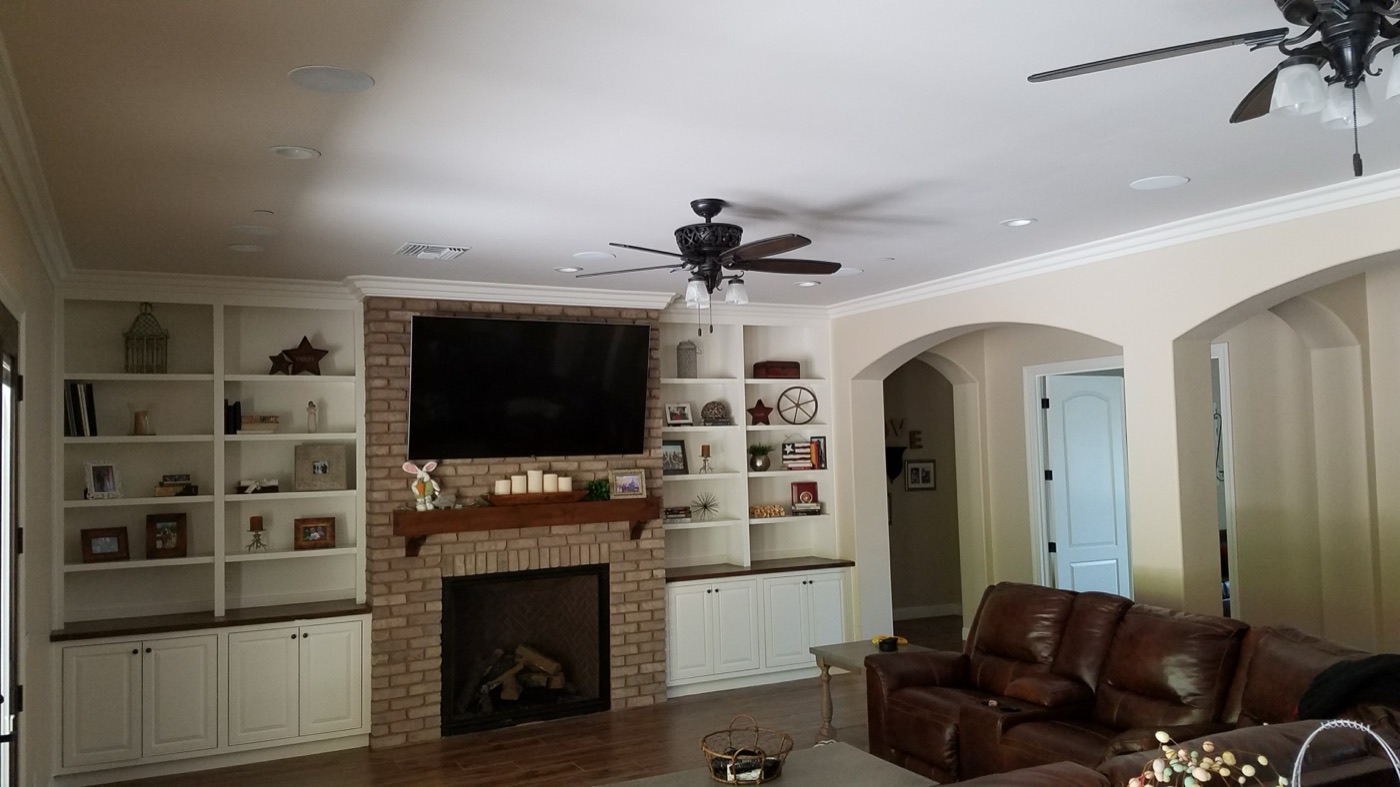
The first big master-planned wave, and now the largest single slice of valley housing. This is the most predictable era we work in: wood frame, 16-inch-on-center studs, drywall inside, stucco over frame outside, vaulted great rooms, and a fireplace in the living room.
The one recurring quirk is that these homes were designed around entertainment centers and armoires, so the wiring layout assumes a TV sitting on furniture rather than hanging on a wall. Longer cable runs are normal. Our Green Valley cost guide covers this era in detail.
2000s–2010s: Southern Highlands, Anthem, Mountain's Edge, Aliante, Providence
Two-story dominant, larger floor plans, more fire blocking in walls, and the first generation with structured-wiring panels in the closet as a standard feature. If your home has one of those panels, check it before assuming anything — there may already be coax and Cat5e/Cat6 runs terminating behind your TV wall, which can save the entire concealment job.
2015–Present: Summerlin West, Inspirada, Cadence, Skye Canyon, Valley Vista
The most mount-friendly homes in the valley, with two caveats.
- Good news: clean framing, reliable cavities, in-wall concealment succeeds on most walls, and many builders offer a TV pre-wire option.
- Caveat one — feature walls. Large-format tile, stacked stone, and flush linear fireplaces are the current design default, and each changes the anchoring approach. See mounting on tile.
- Caveat two — the builder pre-wire is often less than you think. A "TV pre-wire" frequently means a recessed box and an empty conduit at one specific height the builder chose, which may not match where you'd actually mount your TV. Verify what's actually installed rather than assuming.
If Your Home Isn't Built Yet: The Ten-Minute Window
There is a short period during construction — after framing, before drywall — when everything on this list becomes free. If you can get access at that stage, ask for:
- A plywood backer between the studs behind every planned TV location, so mount placement is unconstrained by stud spacing forever
- Conduit, not just cable — a smurf tube from the TV location to the equipment location means future upgrades need no wall work at all
- An outlet at TV height, plus one at floor level below it
- Cat6 to every TV location, even if you plan to use Wi-Fi (see why that matters in stucco homes)
- Speaker runs and a ceiling-speaker layout if surround sound is even a possibility later
Every one of these is trivial before drywall and disruptive after. It's the single highest-leverage thing a Las Vegas homeowner can do for their AV setup, and almost nobody knows to ask.
Frequently Asked Questions
Are older Las Vegas homes harder to mount TVs in?
A little, and mostly in predictable ways: plaster instead of drywall in pre-1960 homes, irregular framing, and outlets that aren't where a wall-mounted TV wants them. None of it is a barrier — it just means the wall gets verified rather than assumed.
Does my new home's builder TV pre-wire cover everything?
Often not. A typical pre-wire is a recessed box and an empty conduit at a height the builder picked. If that height doesn't match where your TV should actually go, or if the conduit doesn't reach your equipment location, there's still work to do.
What should I ask for before drywall goes up?
A plywood backer behind each TV location, conduit from the TV to the equipment spot, an outlet at TV height plus one at floor level, Cat6 to each TV, and speaker runs if surround is a possibility. All of it is nearly free at that stage.
How do I know what era my walls are from?
The year the home was built gets you most of the way. Beyond that, tapping the wall and looking at an outlet cover tells you a lot — and a photo of the wall usually settles the rest before anyone drives out.
Related Reading
TV Mounting Cost in Green Valley · Finding Studs in Las Vegas Homes · Fixing Wi-Fi Dead Spots in Stucco Homes · Structured Cabling Services