Mounting a TV on Brick: Into the Brick or Into the Mortar?
Brick shows up less often in Las Vegas than stucco or block, but where it does — 1970s and 1980s ranch homes around Paradise and the east side, older Henderson properties, and brick fireplace surrounds in newer builds — it's almost always the fireplace wall. That makes it a high-stakes surface: it's the visual center of the room, and every hole is permanent.
The Brick vs. Mortar Question
Ask five installers and you'll get a real split. Both approaches are defensible; they optimize for different things.
| Into the brick face | Into the mortar joint | |
|---|---|---|
| Holding strength | Higher — fired brick is typically stronger than the mortar around it | Lower, and highly variable with mortar age and mix |
| Drilling | Harder, slower, more heat on the bit | Easier and faster |
| Risk while drilling | Brick can spall or crack if hammered aggressively or drilled near an edge | Very low |
| Repairability later | Poor — a filled hole in brick face is visible | Good — repointing a joint is nearly invisible |
| Best for | Heavy panels, full-motion mounts, permanent installs | Lighter loads, renters, anyone who may un-mount later |
Our default on a fireplace surround carrying a large TV is the brick face, with sleeve anchors and careful placement well away from brick edges — the strength margin matters more than the reversibility. For a modest panel on a fixed mount, mortar joints are a perfectly sound choice and leave the wall much easier to restore.
Old Brick Deserves a Closer Look
Brick from the 1970s and earlier can be softer than modern brick, and mortar from that era is often lime-rich and considerably weaker than today's Portland-based mixes. Scratch a mortar joint with a key: if it powders easily, it isn't carrying a TV. That's the case where the brick face is the only reasonable choice, or where the honest recommendation is to build a French cleat across the surround and spread the load over many anchors instead of four.
Technique That Prevents Damage
- Drill in rotation-only mode to start the hole, then add hammer once the bit is seated — hammering from the first second is what chips faces.
- Stay at least an inch from any brick edge; anchors placed near an edge can pop a corner off the brick.
- Go slow and let the bit clear. Brick dust packs and overheats bits, which then wander.
- Vacuum the hole before the anchor goes in. Dust is the reason anchors spin.
- Dry-fit the mount and check level twice. You get exactly one chance at hole placement.
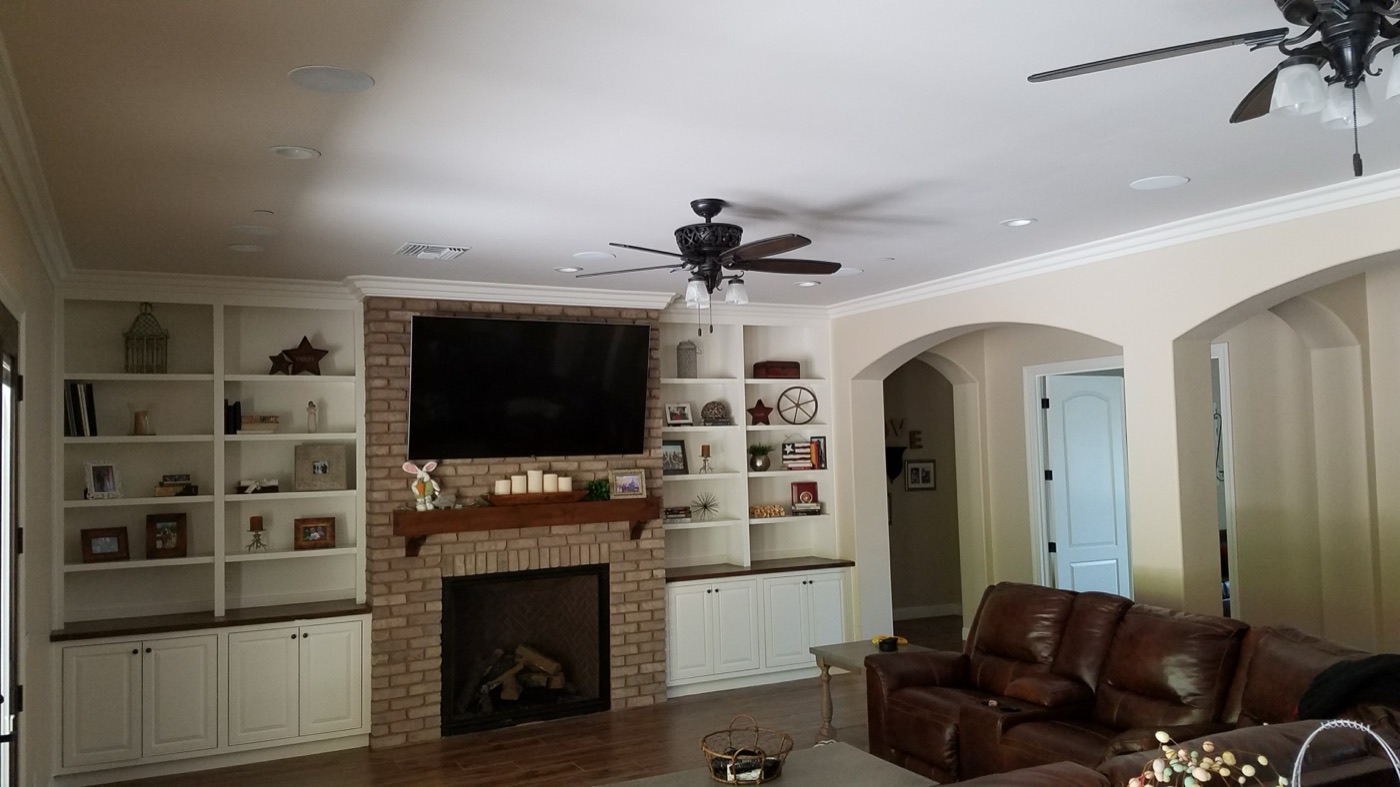
The Fireplace Part of a Brick Fireplace
Anchoring is usually the easy half. The harder questions are height and heat, and they apply to any fireplace mount:
- Height. A mantel pushes screen center well above seated eye level. On a working brick fireplace with a deep hearth, that gap can be substantial. A tilting or full-motion mount with downward tilt is close to mandatory.
- Heat. Consumer TVs are generally specified for ambient operating temperatures up to around 104°F. A wood-burning brick fireplace can push the wall above the mantel well past that during a long burn. Before committing, run the fireplace for an hour and put a thermometer where the bottom of the TV will sit.
- Mantel depth helps. A projecting mantel shelf deflects the rising heat plume away from the screen — one of the reasons brick surrounds with a deep mantel are more TV-friendly than flush modern linear fireplaces.
Our full fireplace mounting guide covers all of this in more depth, including when the honest answer is to pick a different wall.
Cables on Brick
There's no cavity in a brick surround. Cables typically run in a mortar-joint chase, in a color-matched surface raceway down the side of the surround, or — best case — through the framed drywall wall beside the brick and back out behind the TV. If your fireplace has a chase or a bump-out, there's often a hidden path through it worth investigating before defaulting to a raceway.
Frequently Asked Questions
Is it safe to mount a TV above a working fireplace?
It can be, but it depends on how hot the wall above the firebox actually gets. Run the fireplace for an hour and measure the temperature where the bottom of the TV will sit. If it exceeds roughly 104°F, that spot will shorten the TV's life regardless of how well the mount is anchored.
Will drilling into brick crack it?
Not if you start in rotation-only mode, stay away from brick edges, and let the bit clear rather than forcing it. Most cracked brick comes from hammering from the first second or from anchoring too close to an edge.
Can the holes be repaired if I move the TV later?
Mortar joints can be repointed nearly invisibly. Holes in the brick face can be filled, but the patch will usually be visible on close inspection. If you expect to un-mount later, that's a strong argument for the mortar-joint approach.
Do I need a special mount for brick?
The mount itself is the same. The hardware is not — brick needs masonry anchors and a hammer drill, never the wood lag screws that come in the box.
Related Reading
Mounting a TV Over a Fireplace in Las Vegas · Mounting a TV on a Block or CMU Wall · How High Should You Mount a TV? · TV Mounting Services