How High Should You Mount a TV? The Numbers, by Screen Size and Room
Mount height is the decision people regret most, and it's almost always regretted in the same direction: too high. It happens because a TV looks fine when you're standing in the room holding a pencil, and wrong the moment you sit down. Here are the actual numbers, the reasoning behind them, and the specific rooms where the standard answer doesn't apply.
The One Rule Everything Else Comes From
The center of the screen should sit at your eye level when you're seated where you actually watch. That's it. Everything below is arithmetic applied to that principle.
Seated eye level on a standard sofa lands around 40–44 inches from the floor for most adults. Low-slung modern furniture pulls that down toward 36–38 inches; a firm high-seat sectional pushes it toward 45. Measure yours: sit where you watch, have someone hold a tape at the outside corner of your eye, and write the number down. That single measurement is worth more than any general recommendation.
Height Table by Screen Size
A 16:9 TV's height is roughly its diagonal × 0.49. Using a 42-inch seated eye level as the reference, here's where the bottom of the screen lands:
| Screen size | Screen height | Center of screen | Bottom of screen from floor |
|---|---|---|---|
| 50" | ~24.5" | 42" | ~30" |
| 55" | ~27" | 42" | ~28.5" |
| 65" | ~32" | 42" | ~26" |
| 75" | ~37" | 42" | ~23.5" |
| 85" | ~42" | 42" | ~21" |
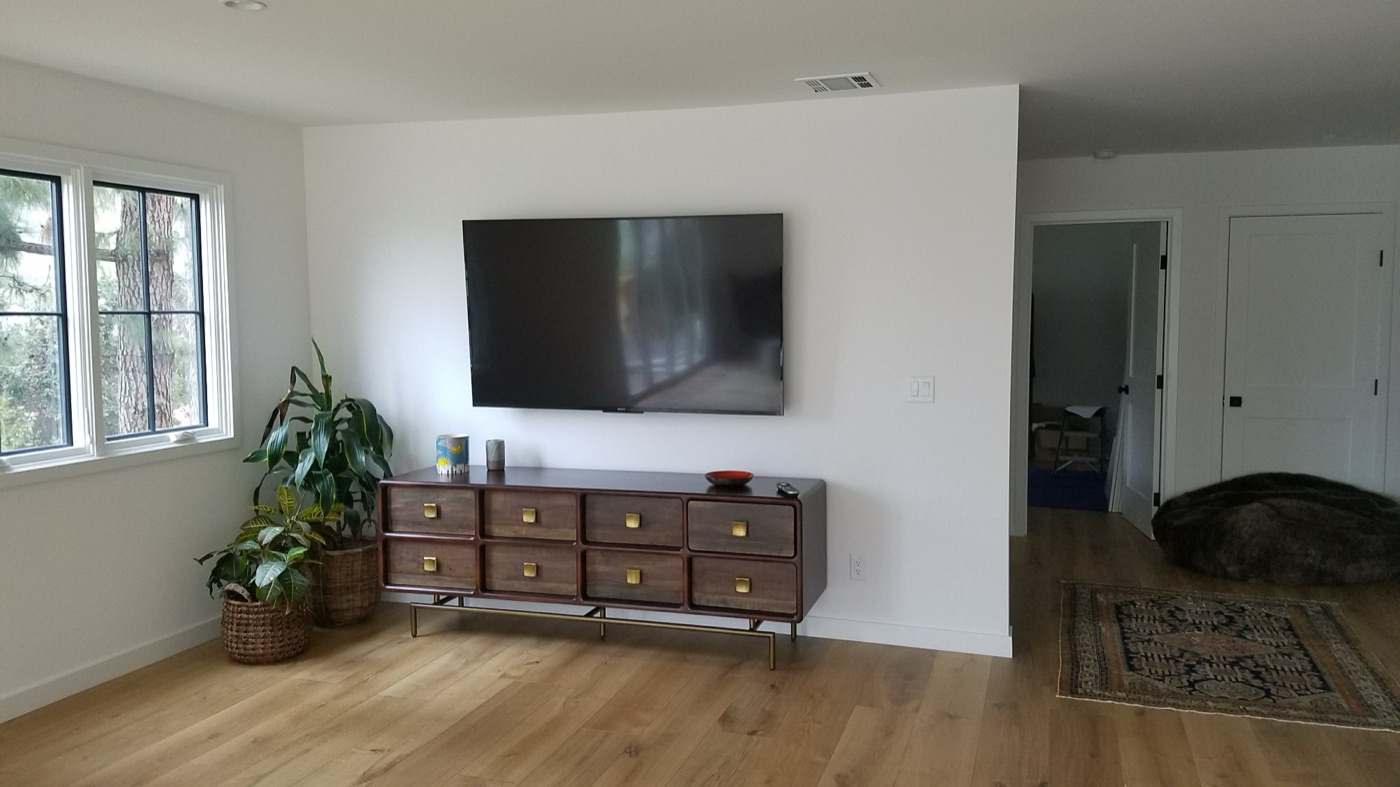
Notice the pattern: as screens get bigger, the bottom edge gets lower, not higher. That's counterintuitive to most people and it's exactly why so many 75-inch and 85-inch TVs end up mounted badly. If you've upgraded from a 55 to a 75 and reused the same bracket position, your new TV is roughly five inches too high.
The Comfort Ceiling
Looking down at a screen is comfortable indefinitely. Looking up is not — sustained upward gaze puts the neck in extension and is the reason "TV neck" is a real complaint after a movie night. As a practical limit, keep the upward viewing angle to the center of the screen under about 15 degrees. Past 30 degrees, most people are uncomfortable within an hour.
Quick sanity check: at a 10-foot viewing distance, every foot the screen center sits above your eye level adds roughly 5–6 degrees. So a screen center at 60 inches with your eyes at 42 inches is about 7 degrees — fine. A screen center at 72 inches is around 14 degrees — the edge of comfortable. Above a tall mantel at 80 inches, you're past 18 degrees and you'll feel it.
Rooms Where the Standard Answer Changes
Bedroom
You watch from a propped-up position, so eye level is higher — usually 48–54 inches from the floor depending on the bed and headboard. Mount to that, and add downward tilt of a few degrees, because you'll sometimes watch lying flatter.
Kitchen and great-room combinations
Very common in Las Vegas open floor plans. If the TV is watched standing at the island and seated in the family room, you're optimizing for two positions at once. A tilting mount at a compromise height — typically 6–10 inches above seated ideal, tilted down — serves both better than either extreme.
Home gym
Eye level on a treadmill is standing height plus a deck, so 60–66 inches to screen center is normal, with meaningful downward tilt. This is one of the few rooms where high is correct.
Patio and outdoor bar
Mostly standing and bar-stool viewing, plus you want the screen out of reach and away from splash. Higher with tilt is the right call. See outdoor TV installation.
Above a fireplace
The hardest case, and the one where the answer is often "pick a different wall." If the fireplace wall is the only option, a full-motion mount with real downward tilt recovers most of the comfort. Full detail in mounting a TV over a fireplace.
Vaulted and two-story great rooms
Tall walls create an optical illusion: a correctly placed TV looks too low relative to the wall's proportions, so people compensate upward and end up with a screen nobody can watch comfortably. Trust the eye-level measurement, not how the wall looks. More in two-story great room mounting.
Test It Before You Drill
Cut a piece of cardboard to your TV's exact screen dimensions, tape it to the wall at the height you're considering, then go sit down and look at it for a couple of minutes. Move it up two inches and look again. This takes ten minutes and prevents the single most common mounting regret there is.
Frequently Asked Questions
Is there one standard TV mounting height?
The commonly quoted figure is 42 inches from the floor to the center of the screen, which matches typical seated eye level. It's a reasonable default, but your own seated eye height and your seating distance both shift it, and bedrooms, kitchens, and gyms all legitimately differ.
Should the bottom of a 75-inch TV really be that low?
Yes — around 23 to 24 inches from the floor if your eye level is 42 inches. Bigger screens are taller, so the center stays at eye level only if the bottom edge comes down. This is the most common mistake people make when upgrading screen size.
Does a tilting mount let me put the TV higher?
It helps, but it doesn't eliminate the problem. Tilt corrects the viewing angle onto the panel, which reduces glare and off-axis picture degradation, but your neck is still looking upward. Tilt is a mitigation for a compromised position, not a license to mount high by choice.
How high should a TV be above a fireplace mantel?
As low as clearance and heat allow — typically a few inches above the mantel shelf, with the shelf itself deflecting heat. Before finalizing, run the fireplace for an hour and check the temperature where the bottom of the TV will sit.
Related Reading
Mounting a TV Over a Fireplace · What Size TV Fits Your Room? · TV Wall Mount Height Guide for Henderson Homes · TV Mounting Services