How TV Size Changes Your Mounting Quote: 55", 65", 75" and 85"
Every TV mounting quote tiers by screen size, and homeowners reasonably ask why. It's not a size surcharge for its own sake. Four concrete things change as a panel gets bigger, and each one adds real work to the install.
Weight Is the First Thing That Changes
Panel weight doesn't climb in a straight line with screen size — it climbs faster, because the chassis, backlight assembly, and stand mount all scale up together. Exact figures vary a lot by model and panel type, but the general shape looks like this:
| Screen size | Typical panel weight | Practical install impact |
|---|---|---|
| 55" | Roughly 35–50 lb | One-person lift; usually lands on a single stud pair |
| 65" | Roughly 50–70 lb | Easier and safer with two people; two studs preferred |
| 75" | Roughly 75–100 lb | Two-person lift; two-stud span effectively required |
| 85"+ | Roughly 110–140 lb | Two-person lift, larger plate, careful hardware verification |
Always check your own model's spec sheet rather than trusting a range — an 85-inch mini-LED and an 85-inch entry-level LCD can differ by 30 pounds.
VESA Pattern and Stud Span
VESA is the spacing of the four threaded holes on the back of your TV, in millimeters. A 55-inch TV is often 400 × 400 or 300 × 300. Big panels commonly run 600 × 400 or 800 × 400. That matters because standard framing in Las Vegas tract homes is 16 inches on center — about 406 mm. A 600 mm or 800 mm wide mount plate naturally spans two studs, which is what you want for a heavy panel, but it also means the mount position is constrained by where the studs actually fall, not by where you'd ideally center the TV. On a wall where the studs land awkwardly, that can mean adding a backer or shifting the layout, and that's labor.
Why the "one stud is fine" shortcut fails at scale
A small fixed mount lag-bolted into a single stud can be perfectly safe. Scale that up to a 100-pound panel on a full-motion arm and the arithmetic changes: when the arm is extended, the load isn't hanging straight down anymore, it's levering outward and trying to pull the top lags out of the framing. Two studs, correct lag length, and full thread engagement stop being nice-to-haves. If your studs won't cooperate, read what your real options are without studs.
Two People, Not One
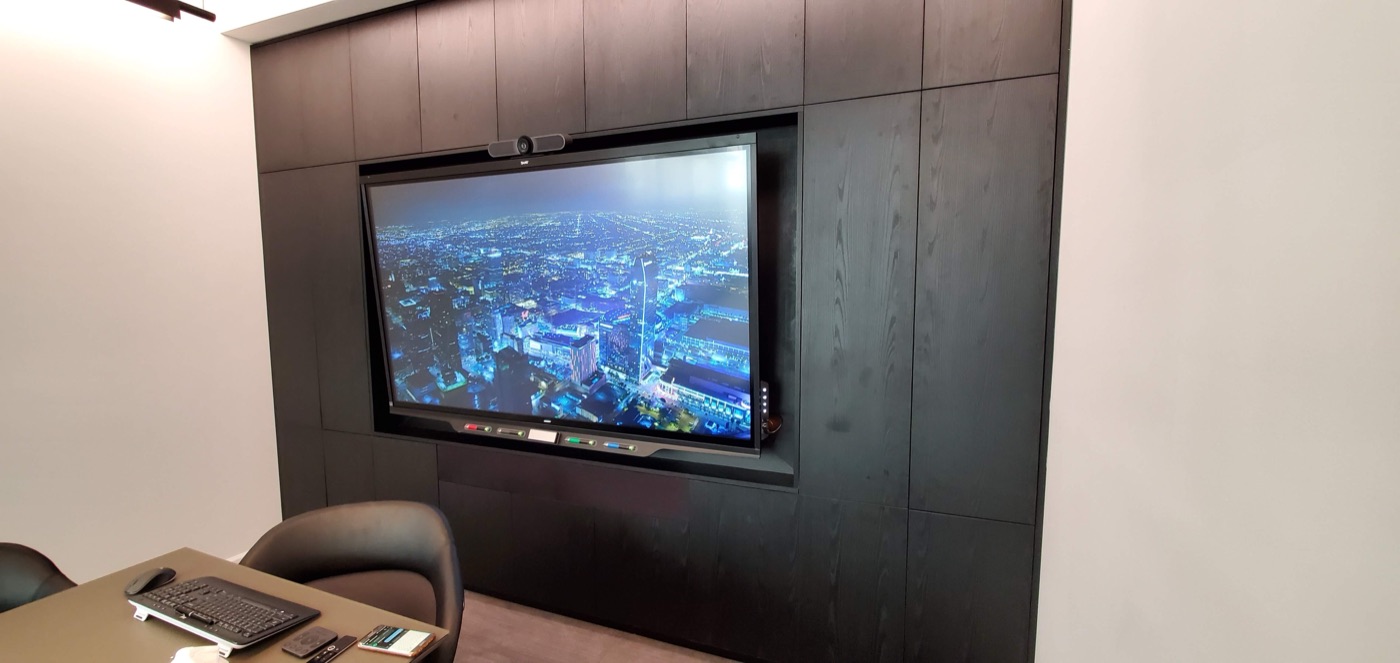
Above about 65 inches, a solo lift onto a bracket stops being a question of strength and becomes a question of control. Getting a wide panel to seat evenly on both hooks of a bracket, at height, without flexing the screen or scraping the wall, is a two-hands-on-each-side job. That's a second set of labor hours in the quote, and it's the honest reason big-screen installs cost more.
Bigger Screens Change the Rest of the Room, Too
Size also cascades into decisions that affect scope:
- Height gets less forgiving. A 55-inch TV mounted a few inches high is a minor annoyance. An 85-inch TV mounted a few inches high dominates the room and strains necks. Our TV height guide covers the math.
- The fireplace option narrows. A large panel above a mantel often lands too high to watch comfortably. See mounting a TV over a fireplace.
- Cable routing needs more room. Big panels sit closer to the wall, so the recess or cable path behind them has to be planned rather than improvised.
- Sound gets noticed. Nobody buys an 85-inch TV and stays happy with its built-in speakers for long. Soundbar or surround is usually the next conversation.
What This Means for Your Quote
Our flat-rate pricing starts at $149 for TV mounting. Size moves a job above that starting rate because of the four things above — weight, hardware, stud span, and crew — not because of a bigger number on the box. Tell us the exact model along with the wall type, and the number you get back is the number you pay.
Frequently Asked Questions
What's the largest TV you'll mount?
We regularly mount 85-inch and larger panels, including 98-inch displays. The limiting factor is never really screen size — it's whether the wall and framing can carry the load safely. Send us the model and a photo of the wall and we'll tell you straight.
Does my 75-inch TV need to be mounted on two studs?
In almost every case, yes — and most 75-inch mounts are designed with a plate wide enough to reach two. Single-stud mounting at that weight relies on a backer plate or masonry anchoring instead, which is a different install.
Can I reuse the mount from my old 55-inch TV on a new 75-inch?
Usually not. Check two things: the mount's stated weight rating against your new TV's actual weight, and whether its VESA range covers the new panel's hole spacing. Many mid-size mounts top out well below what a 75-inch panel weighs. It is not worth guessing on this one.
Related Reading
TV Mounting Cost in Las Vegas (2026) · What Size TV Fits Your Room? · Fixed, Tilt or Full-Motion: Choosing a Wall Mount · TV Mounting Services