DIY or Hire It Out? An Honest Look at TV Mounting
We install TVs for a living, so treat the source accordingly — but the honest position is that plenty of TV mounts are a reasonable DIY project, and pretending otherwise doesn't help anyone. Here's a straight read on where the line falls.
Genuinely Fine to DIY
All of the following true at once:
- Screen 55 inches or smaller
- Standard interior drywall over wood studs
- Fixed or simple tilt mount
- Two studs available where you want the TV
- Cords staying outside the wall, or going in a surface raceway
- You own or can borrow a drill, a level, a stud finder, and a socket wrench
That's a real project with a real chance of a good outcome. Take your time on the level and the stud verification and you'll be fine.
Worth Hiring Out
Any one of these changes the calculation:
- 75 inches and up. Not the drilling — the lift. Getting a 100-pound panel to seat evenly on both bracket hooks at height is a two-person job with a very unforgiving failure mode.
- Masonry, brick, tile, or stone. Requires a rotary hammer, correct anchors, and technique. On tile especially, the mistake isn't recoverable.
- Metal studs. Common in condos. Lag screws don't work and the correct hardware isn't in the box.
- In-wall cable concealment. Involves cutting drywall and, done correctly, a UL-listed in-wall power kit. The DIY shortcut here — running an extension cord inside the wall — is a code violation and a fire risk.
- Over a fireplace. Heat, height, and cable routing all at once. See the fireplace guide.
- High or vaulted walls. Ladder work with a heavy awkward object, often over a raised hearth.
- Full-motion mount on anything large. The leverage math is where DIY installs most often fail months later.
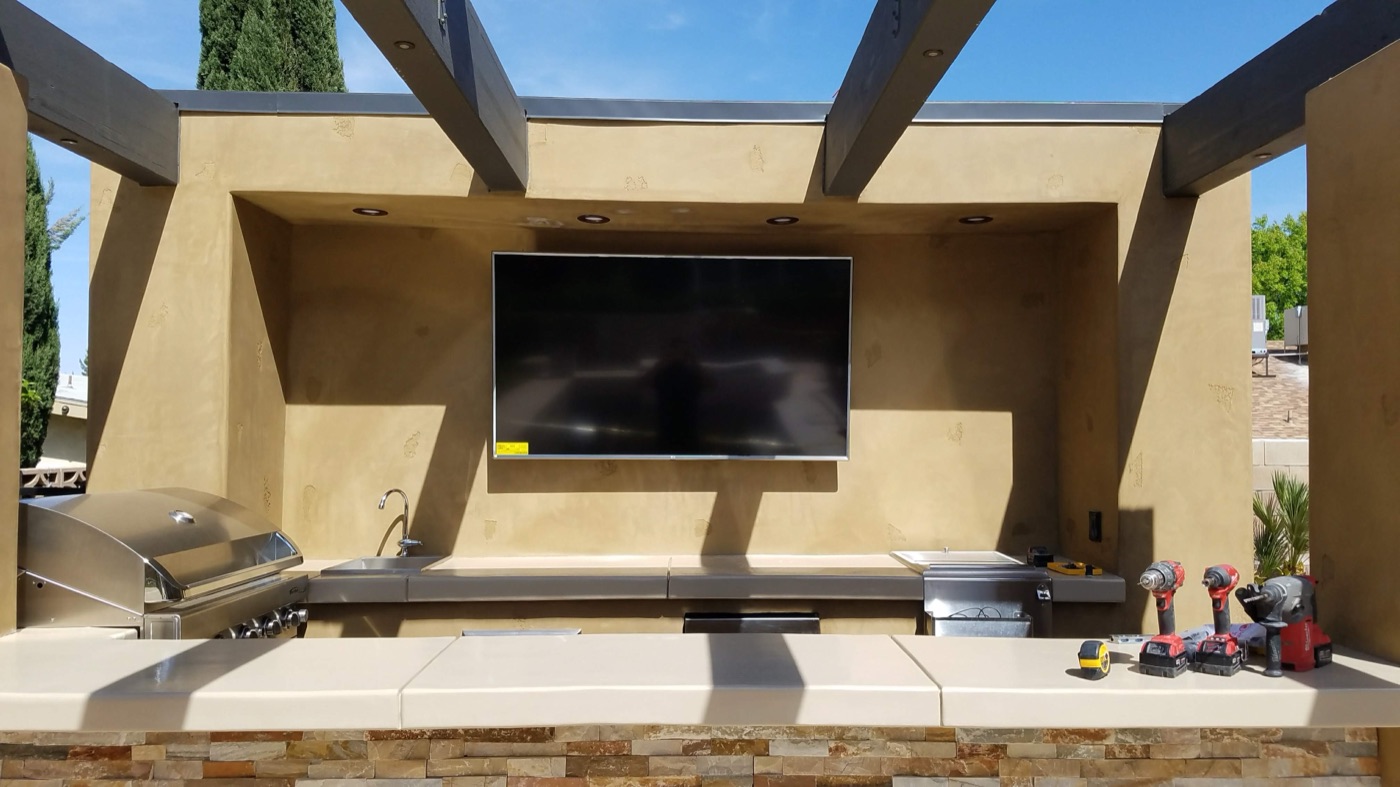
The Four Ways DIY Installs Actually Fail
1. Missing the stud center
Catching the edge of a stud rather than its center means the lag threads into a mix of wood and air. It feels tight at install and works loose over months, which is why the failure usually shows up long after the day everything seemed fine. Verifying properly is the fix.
2. Wrong hardware for the wall
The lags and plastic anchors in the box are for wood studs. Using them in block, brick, or metal studs is the single most common cause of a mount that lets go.
3. Height
Not a safety failure, but the most-regretted one. Almost always too high — see the height guide before you drill, not after.
4. Not level
A half-degree of tilt is invisible on a bare wall and glaringly obvious once there's a picture on the screen and a horizon in it. Level the bracket, then check the TV itself once mounted — TVs don't always hang perfectly square on their bracket.
What It Actually Takes in Tools
For a basic drywall install: a drill with a good bit set, a socket wrench or driver for lag bolts, a 24-inch level, a tape measure, a stud finder (plus a magnet as a cross-check), a pencil, and a helper. For masonry add a rotary hammer and masonry bits. For tile add diamond bits. For concealment add a drywall saw, fish tape or glow rods, a rated in-wall power kit, and low-voltage brackets. Buying the masonry and concealment toolkit for one job costs more than most installs.
The Real Comparison
| DIY | Professional | |
|---|---|---|
| Cost | Mount + tools you don't own | Flat rate, quoted up front |
| Time | 2–4 hours first time, more with concealment | Typically 1–2 hours |
| Wall types handled | Realistically drywall | Any |
| If something goes wrong | Your TV, your wall, your repair | Insured and warrantied |
| Cable concealment | Possible but easy to do unsafely | Code-compliant as standard |
A Middle Path
Plenty of people do the parts they're comfortable with and hire out the rest — mount it yourself, have the wiring concealed properly. Or have the mount installed and do your own device setup. It's not all-or-nothing, and there's no reason to pay for work you'd enjoy doing yourself.
Frequently Asked Questions
Is mounting a TV hard?
A 55-inch TV on a fixed mount, on drywall over wood studs, with two studs where you want them, is a genuinely manageable afternoon project. Difficulty climbs steeply with size, with masonry or tile walls, with metal studs, and with in-wall cable concealment.
What's the most common DIY mounting mistake?
Catching the edge of a stud rather than its center. It feels tight on installation day and works loose over months, which is why the connection to the original mistake usually isn't obvious when the mount finally fails.
Can I run the TV's power cord inside the wall myself?
No — not with an ordinary cord. Flexible cord isn't rated as permanent in-wall wiring. The correct method is a UL-listed in-wall power extension kit with an inlet behind the TV and an outlet lower on the wall.
How long does a professional install take?
A standard mount is typically an hour or two. Adding in-wall cable concealment usually adds 30 to 45 minutes on a straightforward drywall wall, and longer on masonry or where obstructions have to be routed around.
Related Reading
9 Questions to Ask a TV Installer · Finding Studs in Las Vegas Homes · TV Mounting Cost in Las Vegas (2026) · TV Mounting Services